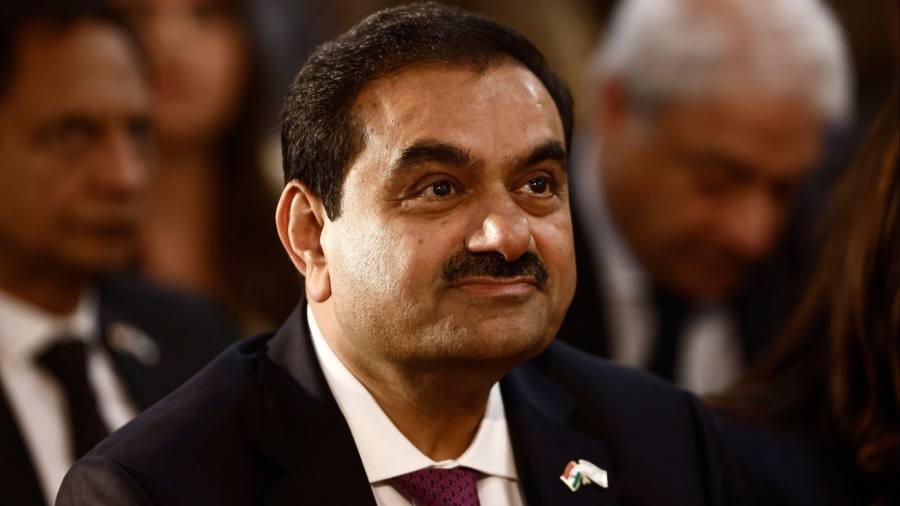
The amount wiped from the value of Gautam Adani’s business empire since a short seller alleged fraud passed the $90bn mark on Wednesday, as a share sale by its flagship group failed to ease a crisis engulfing the Indian tycoon.
Shares in Adani’s listed groups extended their losses in Mumbai, as US short seller Hindenburg Research’s accusations of fraud and stock market manipulation continued to shake investors’ faith in one of the country’s most powerful moguls. Adani denies the allegations.
The sell-off came despite Adani Enterprises raising $2.4bn in a share sale on Tuesday that was intended to broaden its investor base. Adani enlisted some of India’s leading tycoons to help salvage the sale, according to people familiar with the matter.
Entities connected to Sajjan Jindal, the billionaire chair of conglomerate JSW, and Sunil Mittal, the chief of Bharti Enterprises, invested in Adani Enterprises’ share offering, two of those people said.
Other family offices managing money for some of India’s wealthiest business figures were also approached as Adani Group tried to secure backing for the deal, several people told the Financial Times. One tycoon pledged a $60mn investment, said one person with knowledge of the situation.
“On Saturday, it was known in the community that they were approaching high-net-worth families,” said one business figure who was contacted but did not invest. “I know they’ve raised money from family offices.”
JSW and Bharti Enterprises declined to comment. Adani Group declined to comment.
Most bids for the public tranche of the sale came from non-institutional investors, with strong demand from wealthy Indians, according to brokers. Mutual funds did not take part in the sale, while retail investors bid for just 12 per cent of their allotment.
Rajat Sharma, founder of retail brokerage Sana Securities in Delhi, said the reliance on wealthy individuals to push the share sale through spooked other investors. “It’s not good for the company,” he said.
“At some point, they will have to do something to restore their credibility,” he said. “A lot of retail investors are likely to stay away . . . this will dry up the trading volumes.”
In a further sign of stress for Adani, Credit Suisse has stopped accepting bonds tied to Adani companies as collateral for margin loans, according to people familiar with the matter.
The Swiss lender has assigned a zero lending value for notes issued by three Adani companies: Adani Ports and Special Economic Zone, Adani Green Energy and Adani Electricity Mumbai.
As a result, clients who had borrowed money from Credit Suisse using the bonds as collateral would have to provide additional cash or other securities to back the loans, otherwise, they face their securities being liquidated.
The bank had previously assigned a lending value of about 75 per cent on Adani Ports and SEZ notes, according to Bloomberg, which first reported on the moves. Credit Suisse declined to comment.
In another day of frenzied trading, Adani Enterprises tumbled almost 27 per cent, Adani Ports dropped about 18 per cent and Adani Green Energy fell 5 per cent.
The latest falls have left the combined market capitalisation of Adani Group stocks down more than Rs7.5tn ($91.7bn) since Hindenburg released its report, a drop of almost 40 per cent in just over a week.
Adani has vehemently denied the allegations, calling them malicious and discredited, and said Hindenburg was trying to derail the share sale that closed on Tuesday.
Adani Group has grown over the past three years to become one of India’s largest industrial groups across infrastructure and logistics, turning Gautam Adani into one of the world’s wealthiest men.
With reporting by Owen Walker in London
Source: Financial Times