


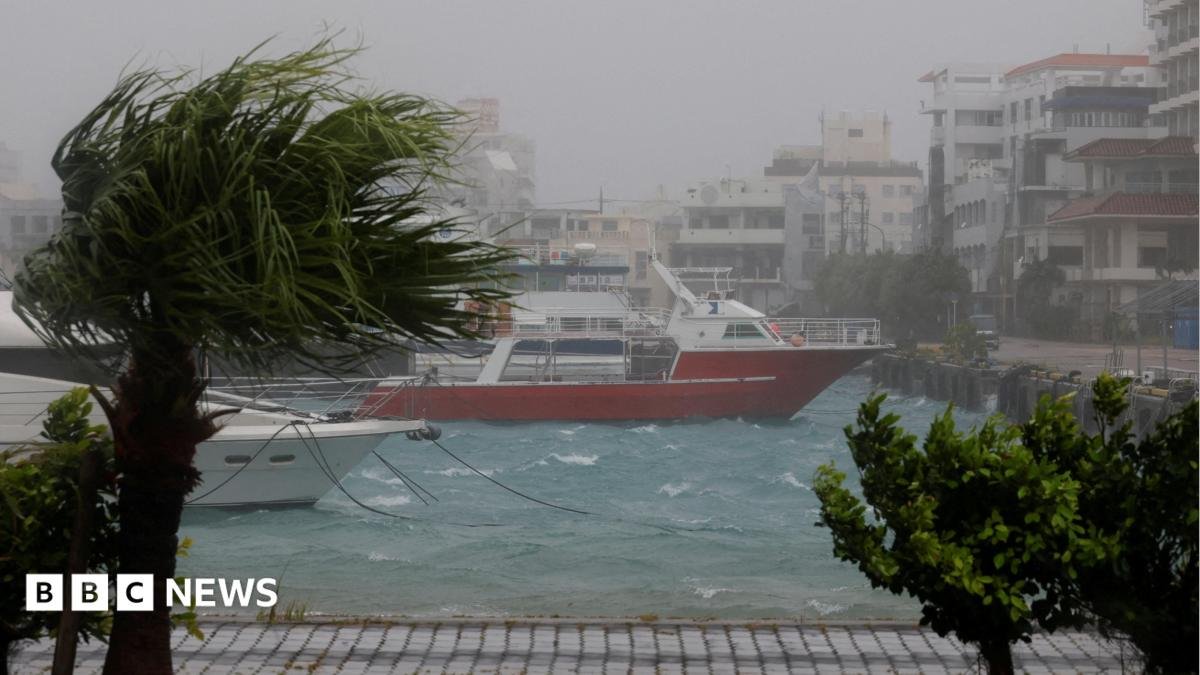
As Typhoon Bavi makes landfall in China for the second time in a week, nearly two million people are huddled in shelters, their lives on hold as the storm unleashes its fury.
The massive storm, which spans 1,000km at its widest point, first came ashore in the coastal city of Taizhou on Saturday evening before making a second landfall in Wenzhou around midnight. According to the authorities, evacuations were “undertaken entirely to guard against the worst-case scenario”, with over 1.7 million people evacuated in Zhejiang and thousands more in neighbouring provinces.
State media reports that schools, work and outdoor activities have been suspended in Zhejiang, while 400 flights and dozens of train services have been cancelled. The city of Wenzhou, home to around 10 million people, is close to the path of the storm, with authorities evacuating hundreds of thousands of residents. Beijing had ordered the evacuation of 100,000 people to “avoid risk”, officials said.
As Typhoon Bavi battered Guam and the Northern Mariana Islands last Monday with wind speeds of 290km/h, it was clear that the storm was no ordinary weather event. Since then, it has weakened to a severe tropical storm, but still presents a risk because of the huge volume of moisture within its rain bands.
According to the National Meteorological Centre, Bavi is forecast to bring “exceptionally heavy rains” to eastern Zhejiang province and northeastern Fujian province on Sunday. The storm’s trajectory, which has already claimed at least 17 lives in the Philippines, has raised concerns about the potential for landslides and flooding in China’s coastal regions.
As China’s disaster response is put to the test, authorities are racing to mitigate the effects of the storm. With the country’s second major storm in a week, the government’s ability to respond to natural disasters will be closely watched. Can China’s disaster response infrastructure withstand the pressure of back-to-back storms?
As Typhoon Bavi continues to wreak havoc, residents are bracing themselves for the worst. With the storm expected to gradually diminish in its intensity as it moves north-west, the focus will shift to the aftermath, and the long road to recovery.
According to state media, the authorities are preparing for the possibility of “exceptionally heavy rains” in eastern Zhejiang province and northeastern Fujian province. The storm’s impact will be closely monitored, as the country’s disaster response infrastructure is put to the test once again.
As the storm begins to dissipate, the question remains: what will the full extent of the damage be, and how will China’s disaster response infrastructure hold up to the pressure?