

Welcome back.
A blinkered focus on climate in western capitals has contributed to the upheaval sweeping through energy markets today.
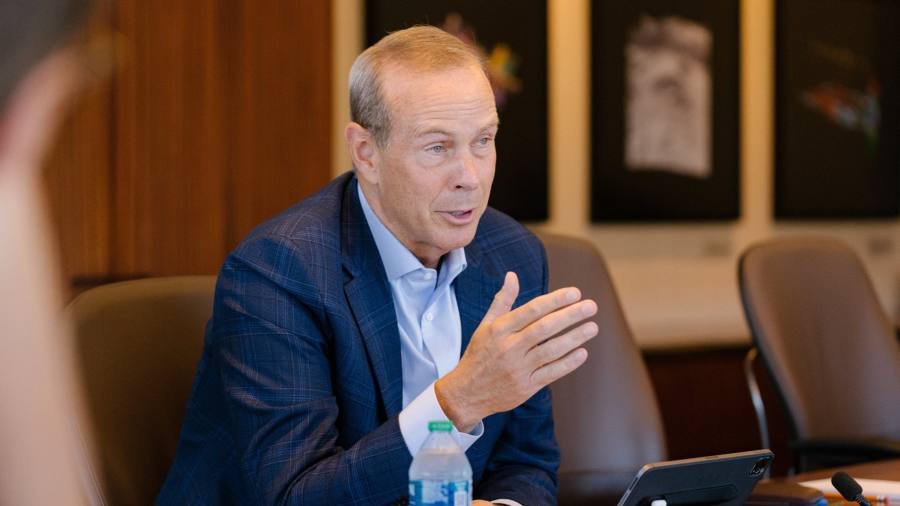
That was what Chevron boss Mike Wirth told Derek in a recent interview at the supermajor’s California HQ. You can read the full piece here.
Today’s newsletter further dissects the views of one of the world’s top oil executives on everything from the “energy dilemma” (Wirth didn’t want to use the term “crisis”) facing Europe this winter to the need for swifter permitting reform in the US.
Elsewhere, the fallout from Opec+’s bombshell production cut rumbles on.
In its latest oil market outlook report Opec revised down its demand forecast for this year — but hardly enough to justify last week’s sweeping intervention. In Washington, tempers are running high. Our second note is on the latest moves in the unfolding US-Opec saga.
Until next week, thanks for reading. — Myles
Mike Wirth: There’s a lack of ‘balance’ in the energy debate
“It’s a very polarised conversation. You’re either for or against the energy transition; for or against mitigating climate change.”
That’s from Mike Wirth, Chevron’s chief executive, and he is not impressed with the discourse on energy at the moment.
The lack of “balance” when policymakers and others talk about energy was the central message Wirth wanted to convey in our interview.
He might be on to something. For some of Big Oil’s critics, the idea that the FT would even sit down with the Chevron CEO is these days a problem. For Big Oil’s boosters, it is climate activists who are doing more harm than good. Witness the virulent social media response to anything Joe Biden or Greta Thunberg says about climate these days.
Here are some of Wirth’s thoughts on other areas:
On Europe
Wirth said the supply issues across the Atlantic would not be quickly resolved.
“If they come through this winter and have drawn those inventories down and you don’t have the same amount of gas flowing in to the continent . . . it sets up for an even more difficult winter the following year. So we won’t be out of this quickly.”
Geopolitics
How bad is the energy crisis?
“We’re looking at I think, a pivotal point in geopolitics — in the relationship between the west and the east . . . The Middle East has historically been largely aligned with the west. I’m not sure that necessarily can be said today.”
Meanwhile, “we’re seeing a slowing economy in the US” and a global economy “on the verge of a slowdown or recession”.
Russia will be back
“Never’s a long time,” Wirth said, when I asked him if Russia’s energy would ever make a return. “I think it’s all dependent upon how the conflict, politics, personalities play out over time. But it is a large resource near a large market. And those are very powerful forces.”
Defence of oil and Chevron’s growth plans
Chevron is not interested in shrinking oil output, as BP and Shell have pledged.
“I was asked a year ago in a congressional hearing under oath to pledge that we would never again produce as much oil as we were producing at that time. And I I refused to agree to that because the world needs more energy, not less. Our plans are to grow.”
COP27
Should oil companies be at November’s UN climate conference in Egypt?
“I’d like to believe that there is a seat at the table for our industry,” Wirth said.
Oil majors had the resources and experience to help build a low carbon energy system, he said, so “to exclude those companies from the conversation is to exclude some of the entities that can help the world make progress”.
Low-carbon technology
Chevron’s low-carbon investments remain much smaller than its spending on fossil fuels. Will that change?
“We’ve laid out a plan to spend $10bn over the next few years on this, I hope we find opportunities to invest more than that, that are economic.”
Meanwhile, its carbon capture business will not be used for enhanced oil recovery, Wirth said. As for Chevron’s Gorgon liquefied natural gas project, where the Australian carbon capture plant has captured much less carbon than planned, he said: “Gorgon as a project in total is one where we haven’t performed as well as we would expect.” But “there’s nothing all in our experience there that would condemn [carbon capture, utilisation and storage] as a concept”.
Permitting
The Inflation Reduction Act was a “mixed bag” for Chevron, with tax breaks for carbon capture and hydrogen but little for renewable fuels, Wirth said. But permitting reform remained essential.
“If we can’t streamline the permitting process, the agency roles, the litigation that can be used to stop just about anything, we’re going to have a hard time building the energy infrastructure that this country needs — and that includes the renewable infrastructure.”
(Derek Brower)
Opec continues to create problems for the White House
Opec yesterday slashed its oil demand outlook again — the fourth time it has done so since April.
Crude consumption this year and next will be less than it had envisaged a month ago, it said, pointing to the looming spectre of global recession and persisting Covid-19 restrictions in China.
Justification then, for the cartel and its allies’ decision last week to cut output by 2mn barrels a day from November? Hardly.
Opec now expects the world to guzzle 99.7mn b/day this year. That might be down slightly from the 100mn b/d it predicted last month, but it is still a rise of 2.6mn b/d on last year. The group’s demand estimate of 102mn b/d for 2023, also down slightly, would still be a jump of another 2.3mn b/d.
That moderate curtailment of the demand picture does not suggest Opec sees the world entering a state of economic freefall of the sort that would soon pull planes from the skies and cars from the roads.
The figures do not quite chime with the cartel’s argument that without its intervention to keep prices elevated, investors would abandon the sector or that, in the words of UAE energy minister Suhail Al Mazrouei, production would “fall from a cliff”.
Pundits can argue over whether the move was intended as a gift to the Kremlin or a rebuke to the White House, but it does not appear to have been a technical alignment of supply and demand. The decision continues to reverberate globally — not least in Washington.
President Joe Biden on Tuesday insisted Saudi Arabia would pay a price for bucking the wishes of the White House, its longstanding ally. “I’m not going to get into what I’d consider and what I have in mind. But there will be consequences,” he said in a CNN interview.
Top Democrats such as New Jersey’s Bob Menendez, Senate foreign relations chair, and Dick Durbin of Illinois are pushing to halt arms sales to Saudi Arabia.
“Nopec” legislation is back on the cards, receiving Republican backing in the form of Iowa senator Chuck Grassley.
Meanwhile, Joe Manchin is using the fallout to push his own hobby horse — permitting reform. His bill to slash red tape for pipelines and transmission wires hit the buffers last month.
But the West Virginia senator said yesterday that the “reckless steps” taken by Opec+ “have made it clearer than ever that the United States must step up and increase our energy production”. Rather than looking to unfriendly foreign powers to fill the gap, Washington should be making it as easy as possible for US producers to pump more.
Still, even as tensions run high, analysts say there may be little option for Washington, but to co-operate with Opec in order to secure supply — especially as its European allies face a bleak winter.
As Helima Croft at RBC Capital Markets puts it:
“White House officials may have to decide how much anger they want to unleash against the holders of spare capacity or whether they should channel their diplomatic efforts to securing guarantees that these nations will surge supply to Europe come December to meet any major disruption and prevent a potentially ruinous outcome for the continent.”
(Myles McCormick)
Data Drill
Countries should not postpone climate action to tackle inflation and energy security, the IMF warned in its grim economic outlook on Tuesday. The fund reduced next year’s growth forecast to its lowest since 2001 because of soaring food and energy costs, Russia’s invasion of Ukraine, and the lingering Covid-19 pandemic.
The IMF looked at multiple decarbonisation scenarios and found that the energy transition will have a minimal impact on global GDP and inflation. The fund estimates global growth will slow by 0.15 to 0.25 percentage points annually and inflation could be 0.1 to 0.4 percentage points higher depending on the decarbonisation scenario.
In a separate report on Tuesday, the IMF also called for greater private climate financing in emerging markets, which make up two-thirds of global greenhouse gas emissions. These regions faced a $1.6tn investment gap in climate mitigation and adaptation in 2020, with Central Asia and eastern Europe and the Middle East and Africa requiring annual investments worth more than 8 per cent of their GDP.

Power Points
-
Germany slashed its growth forecasts for the next two years, blaming Russia’s Vladimir Putin for pushing its economy towards economic recession.
-
European wind turbine manufacturers are cutting jobs amid rising material costs and supply chain delays.
-
US nuclear group Westinghouse Electric was sold to a private equity consortium for $7.9bn in a bet that the war in Ukraine will revive the sector’s fortunes.
-
“Too male, pale, and stale”: Young women are campaigning for equal representation in the COP27 leadership team.
Source: Financial Times