


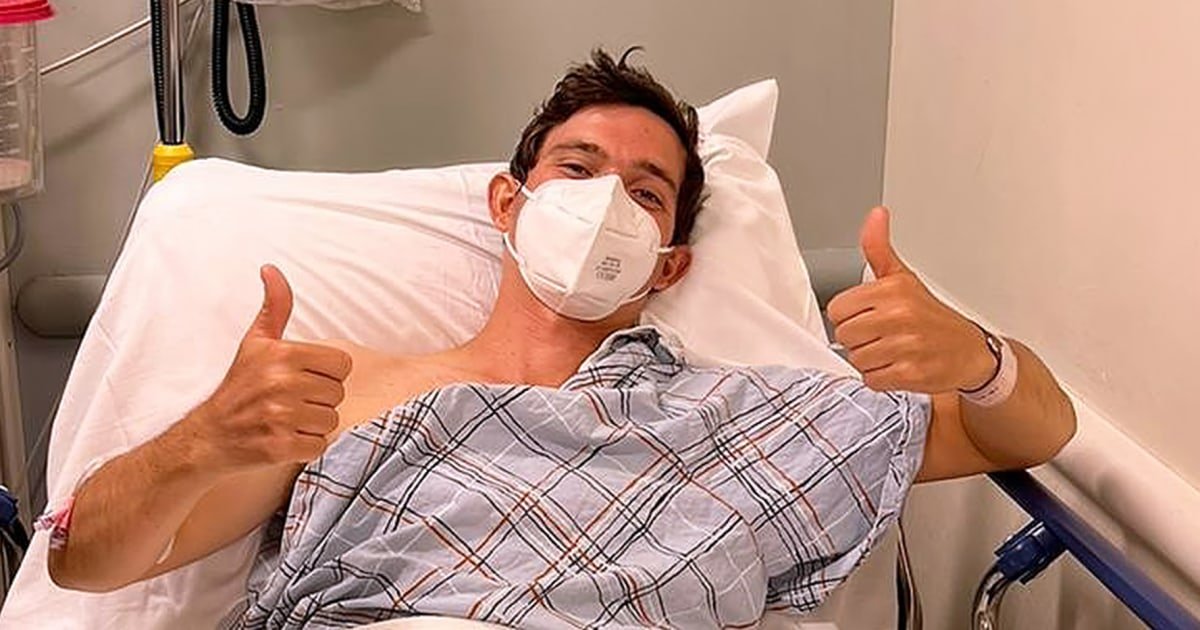
When professional golfer Luis Vega woke up with back pain while on vacation in New York City, he figured he’d slept in an odd position. Vega and his girlfriend, Claudia Rebesco, went on to have a pretty normal, pain-free day, and the two even went cycling around the city.
But the next night, things got much worse — quickly.
Vega, 26, woke up in the middle of the night with more severe pain in his back and a headache. He took a shower to soothe the pain and Rebesco, a physical therapist, gave him some exercises and breathing tips to get back to sleep.
But a few hours later, Vega woke up again, and this time he was unable to move his legs. At first, he thought maybe his legs had just fallen asleep. But when Vega still wasn’t able to move his legs two hours later, he and Rebesco knew something was very wrong.
“I tried to get up to have another shower, and when I tried to get up from the bed, I just literally fell off,” Vega told TODAY. “My legs were not able to handle the weight of my body, and that was pretty scary.”
There were two possible causes for Vega’s paralysis
As it turned out, Vega was staying in a hotel across the street from Mount Sinai West in New York City. So his girlfriend and her family in the city were able to rush him into the hospital and get imaging tests done quickly.
An MRI revealed two possibilities: It was likely that Vega either had a tumor or a hematoma (blood clot) putting pressure on his spinal cord, Dr. Wesley Bronson, spine surgeon and assistant professor in the department of orthopedic surgery at Mount Sinai, told TODAY.
But Bronson wouldn’t know for sure what was causing Vega’s symptoms until he performed an emergency spinal surgery.
A “remarkably rare” diagnosis
“It was obvious immediately that he just had a big blood clot, and it was very compressive,” Bronson revealed. “You could really tell it was putting pressure on the spinal cord.”
As soon as Bronson removed the blood clot, “the sac that the spinal cord lives in immediately started to re-expand and take up the appropriate amount of space,” he said.
The condition Vega developed, which Bronson described as “exceedingly rare,” is called a spontaneous epidural hematoma. Essentially, that means that Vega had a spontaneous bleed in his spine, which became large enough to put significant pressure on his spinal cord — to the point that it caused paralysis in his legs, Bronson explained.
People who develop the condition typically have certain risk factors, such as clotting disorders or underlying abnormalities in their blood vessels that predispose them to bleeding issues. Taking certain medications, such as blood thinners, can also be a factor. Additionally, there are some case reports of weightlifters developing spontaneous epidural hematomas during an intense workout, Bronson noted.
But Vega’s medical team performed test after test and found nothing that would put him at risk for the condition. “He had a remarkably rare diagnosis and had no risk factors at all for it to happen,” Bronson said. “So, (his case is) the rarest of the rare.”
Recovery began almost immediately
After Bronson performed an emergency laminectomy — when “a small piece of the back part (lamina) of the small bones of the spine” is removed, according to Mayo Clinic — he still wasn’t sure if Vega would be able to move again. “From the moment I took the pressure off his spinal cord in surgery, I had no idea if he would wake up moving or not,” Bronson said.
But from there, Vega’s recovery was “fantastic,” Bronson said.
Right after the surgery, Vega still had some weakness in his legs. But the next morning, he was able to stand. And over the next few days, he regained all of his strength. “The next day I was able to move my legs and all my toes and stand up,” Vega recalled. “And in one day, I went from not being able to walk to walking again.”
So, will Vega be able to go back to golfing one day? “100%. He’ll have no restrictions,” Bronson said.

But Vega, who lives in Italy, is taking things slow and doesn’t want to push himself too far. Returning to his sport is “the only thing I don’t want to rush,” Vega said. He has a meeting with his medical team in Spain in mid-November, which will mark 12 weeks since surgery and determine when he can start practicing again, he said.
While Vega and his medical team still don’t have concrete answers about why this happened, he’s just focusing on recovery — and how lucky he’s been in such an unlucky situation.
Not only did he happen to be staying across the street from the hospital, but he received care there very quickly, which gave Vega even better chances for a full recovery, Bronson said.
“The longer that spinal cord is pinched and the longer (a patient) remains paralyzed, the less of a chance that they ever regain the ability to walk,” he explained. “But we were able to take care of this immediately.”
And even when Vega was in the hospital and facing the possibility that he may never regain the ability to walk, his spirits were high. As he told Rebesco at the time, “It’s really tough to beat me.”
Related:
Source: Today