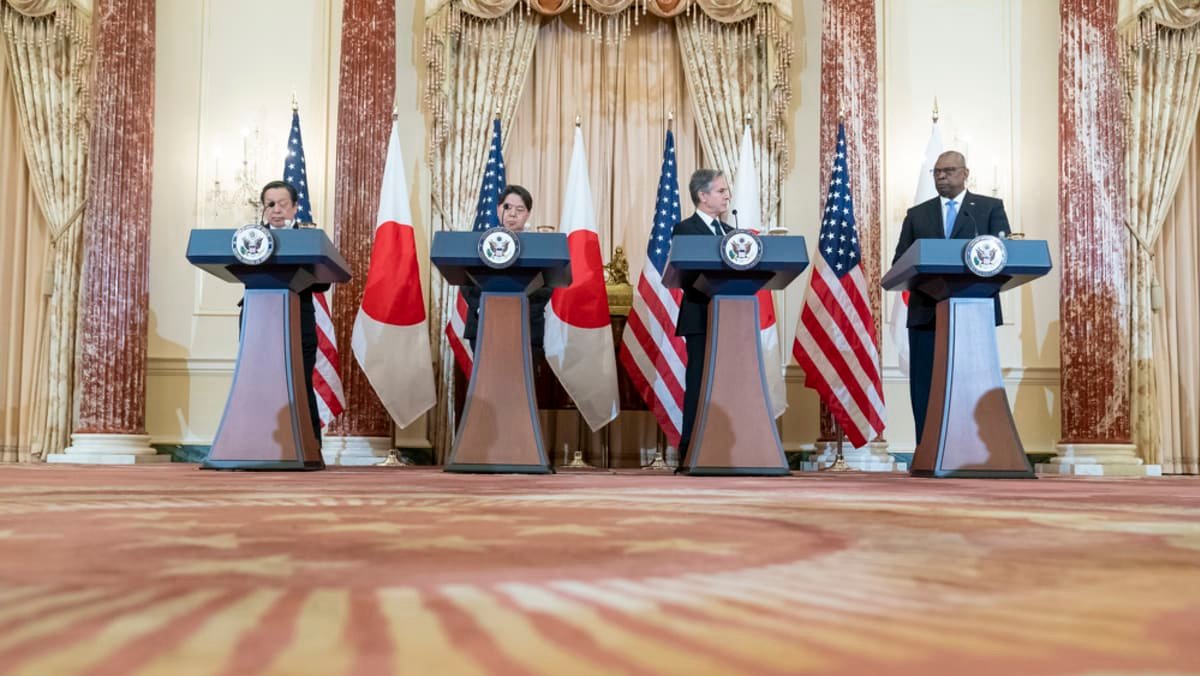
Austin noted that the agreement affirms America’s “ironclad commitment to defend Japan with a full range of capabilities, including nuclear” and underscores that Article 5 of the mutual security treaty applies to the Senkaku Islands. The disputed islands outside Japanese territorial waters are also claimed by Beijing.
The statement also adds a formal mention of space in the longstanding security treaty, making clear that “attacks to, from and within space” could trigger the mutual defence provisions of the treaty, according to an administration fact sheet. That had previously been outside the scope of the agreement.
Earlier on Wednesday, Japan said it would soon begin constructing a pair of runways on the small southern island of Mageshima where the two militaries are to conduct joint exercises, including those of F-35B stealth fighters, amphibious operations and missile interception beginning around 2027.
The construction could start as early as Thursday, it said. The island, off the southwestern coast of Kagoshima on the southernmost main island of Kyushu, will be a hub for troop deployment and munition supply in case of a conflict like a Taiwan emergency.
Japan and the United States are moving one of their key flight exercise sites to the southern island, which is much closer to the US air base of Iwakuni, home to an F-35B fleet, than the current training site on Iwo Jima, where one of the bloodiest and most iconic battles of World War II was fought.
The changes in the deployment on Okinawa will transform the 12th Marine Regiment into a smaller, more rapidly mobile unit – the 12th Marine Littoral Regiment, which will be designed to be better equipped to fight an adversary and defend the US and its allies in the region, US officials said.
Austin said the regiment will bring “tremendous” capabilities to the region as a “more lethal, more agile, more capable” military unit.
The officials said the decision will not increase the number of Marines on the island and does not come with any significant change in weapons capability.
Reinforcement of military capability or troops is a sensitive issue for Okinawa, site of one of the bloodiest ground battles at the end of World War II. The island hosts more than half of the US troops based in Japan, and Okinawans want that number reduced.
A senior administration official, who requested anonymity to discuss negotiations with the Japanese, said historically negotiations involving US force posture in Okinawa have been “unbelievably fraught, incredibly challenging and difficult” and often took years to complete. But negotiations before Wednesday’s meeting were completed with striking speed, the official said.
The agreements follow Japan’s announcement last year that it would increase its defence spending to 2 per cent of gross domestic product over five years. That would make its defence budget the world’s third-largest – a dramatic shift in Tokyo’s priorities that reflects growing concerns about North Korea and potential Chinese military action against Taiwan.
While there is a growing fear of a Taiwan emergency, many islands in the region are concerned that a defence buildup could increase the risks of getting embroiled in war.
The change in Okinawa is part of a broader shift being made across the Marine Corps to make the service better able to operate in contested areas, particularly within striking range of an enemy. That element is critical in the Indo-Pacific, where thousands of US and allied forces are easily within missile – or even rocket – range of both China and North Korea.
One Marine littoral regiment has already been set up in Hawaii, the second would be in Okinawa.
Details are still being worked out, but a littoral regiment is made up of roughly 2,000 Marines, and includes a combat team with an anti-ship missile battery, a logistics battalion and an air defence battalion. The current Marine regiment on Okinawa that it would essentially replace includes about 3,400 Marines and sailors. The overall number of Marines on Okinawa would remain about the same, officials said.
Dr Ellis Krauss, a leading expert on US-Japan relations, said the deeper, more comprehensive alliance will strengthen Japan’s defence posture, “to counter what they see and much of the world sees as an increasingly aggressive China and the threat of North Korea”.
“You can’t deter by weakness, you can only deter by some form of strength. That’s on the one side,” he told CNA’s Asia First.
“On the other side, of course, there’s always the danger that what is defensive on the part of the US and Japan will be perceived by China as more offensive.”
Source: CNA