

Low-lying Bangladesh is considered among the most climate-vulnerable countries, with the impact of rising waters compounded by storms, floods and erosion.
The climate impact is being compounded by natural factors, such as tectonic shifts that are causing the land beneath to sink, and upstream dams holding back silt that would replenish the eroding delta.
Between 2000 and 2019, Bangladesh was ranked seventh in a list of countries hit hardest by climate change, according to the Global Climate Risk Index 2021 produced by non-profit Germanwatch.
“Because it is the largest delta in the world … a huge portion of Bangladesh’s land area experiences frequent flooding, especially flash floods along with river erosion,” the Asian Development Bank said in a 2021 report.
Bangladesh is also frequently hit by cyclones that barrel up the Bay of Bengal, while global warming makes rainfall patterns increasingly erratic. More than a quarter of Bangladesh’s population of 165 million live in the coastal zone.
Rising sea levels and coastal erosion could cause Bangladesh to lose 17 per cent of its land surface and 30 per cent of its food production by 2050, according to a 2019 International Monetary Fund report.
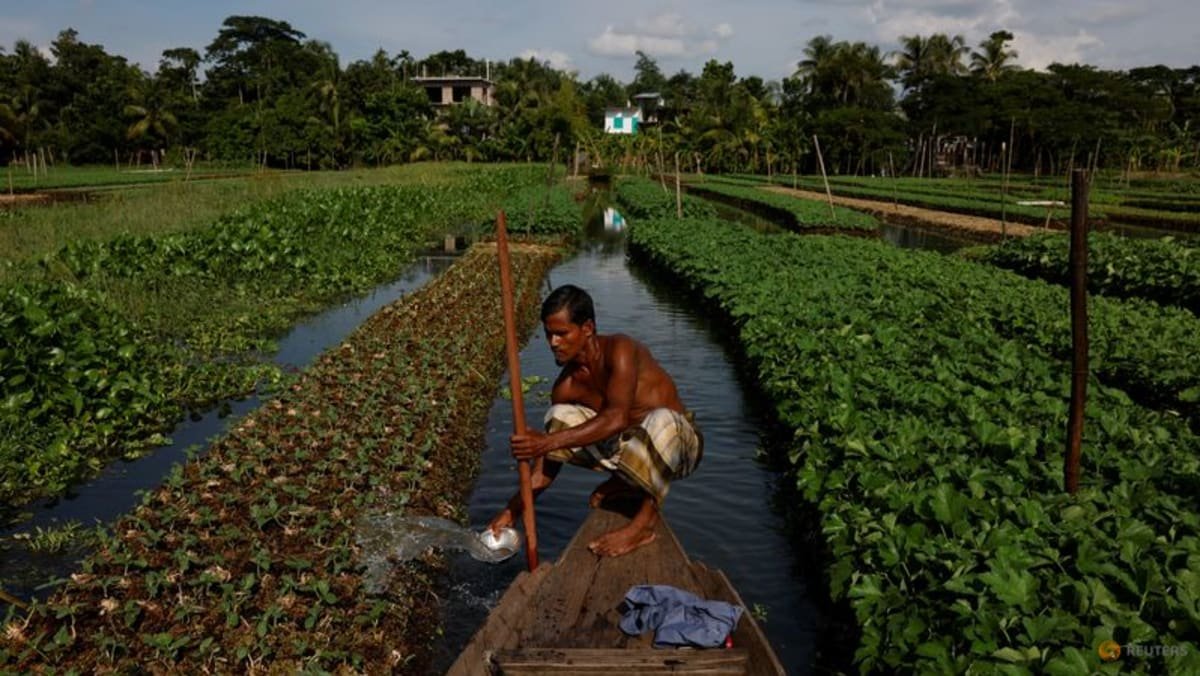
Navigating a boat along one of the country’s countless waterways, Mostafa said that he is now able to feed his family “without asking for help”.
The profit margins, however, have been shrinking as costs rise, he added. This year, he spent about 4,500 taka (US$43) for a boatload of water hyacinths weighing about 1.2 tonnes to weave into new rafts for the year. Last year, the cost was just 1,000 taka.
The rafts, which take two months to make, are typically around 6m long and 1m wide, but can be several times that length, farmers said. They need to be replaced with new ones after three to four months.
Mohammad Ibrahim, another farmer in the area, said that the floating beds allow him to grow more crops reliably.
“Water levels are rising. I still can remember I used to play football in the land that now goes underwater during the normal tide,” the 48-year-old said as he sold gourd saplings that he grew on the floating beds on a boat.
The effort is not without cost.
His wife Murshida Begum, 35, said that she works more than eight hours a day making balls of seedlings that are planted on the rafts, but the hyacinths often cause itching and sores across her palms and fingers.
Kajol Begum, a 30-year-old mother of two daughters, said: “The work is so hard and painful. I can’t sleep at night due to waist pain. But what else will I do when water is everywhere most of the time?”
Source: CNA